
Protecting Fish from Temperature Stress – Pond Aeration
Feb
Why You Shouldn’t Place Your Aeration Diffuser at the Deepest Point of Your Pond
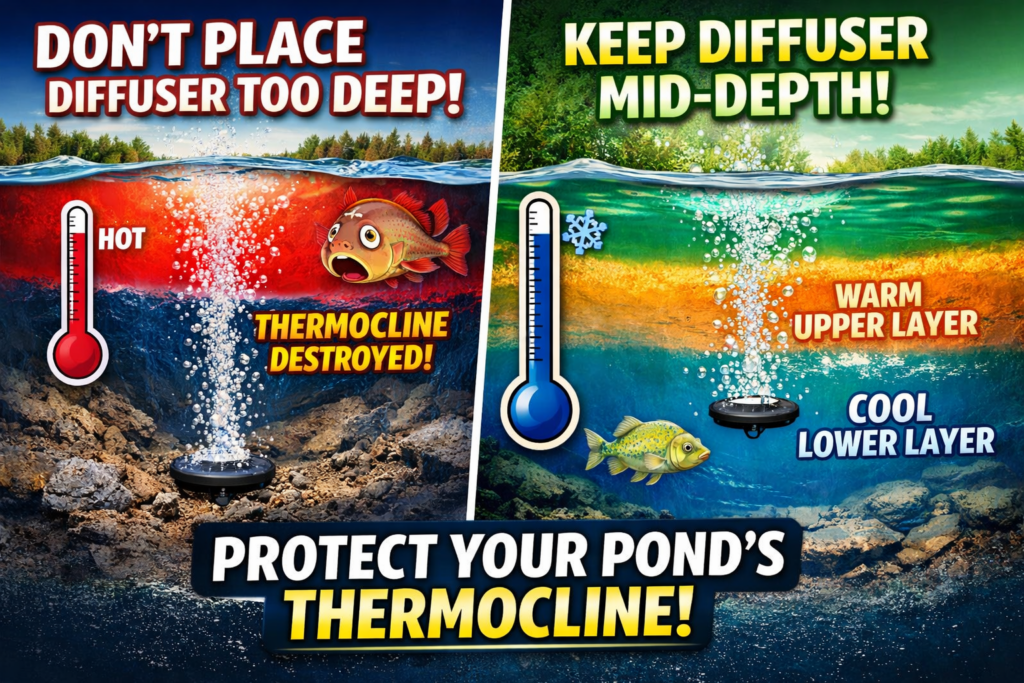
Pond aeration is essential for maintaining healthy water quality, supporting beneficial bacteria, and sustaining thriving fish populations. However, where you place your aeration diffuser is just as important as installing one in the first place. A common mistake pond owners make is positioning the diffuser at the very deepest point of the pond, assuming that deeper placement provides better aeration. In reality, this approach can disrupt the pond’s natural balance and even stress—or kill—your fish.
Understanding the Natural Thermocline
Most ponds naturally develop a thermocline, a layered temperature structure where warmer, oxygen-rich water stays near the surface and cooler, denser water settles near the bottom. This layering is especially important during the hottest parts of summer and the coldest periods of winter because it creates temperature zones that fish use to regulate their metabolism and comfort.
When a diffuser is placed at the deepest point, it forces rapid vertical mixing of the entire water column. This can collapse the thermocline quickly, causing sudden temperature changes throughout the pond. Fish that rely on these layers for comfort suddenly lose their refuge and may experience severe thermal shock.
Why Half-Depth Placement Works Better
Positioning the diffuser at approximately half the pond’s depth provides an effective balance. At this level:
- Oxygen is still distributed throughout the pond, including deeper areas, through gradual circulation.
- The bottom water receives aeration more slowly and gently, reducing the risk of abrupt temperature mixing.
- The natural thermocline remains largely intact, allowing fish to move between temperature zones as needed.
Even though the diffuser is not sitting directly on the bottom, the rising air column still creates enough circulation to improve oxygen levels near the pond floor—just at a safer, more controlled rate.
Protecting Fish from Temperature Stress
Fish depend heavily on stable temperature gradients. During hot summers, deeper, cooler water offers relief from heat stress. During cold winters, slightly warmer bottom water can be critical for survival. If full-depth aeration rapidly eliminates these temperature layers, fish may be forced into conditions they cannot tolerate, leaving them with no area to acclimate gradually. Sudden shifts in temperature and dissolved oxygen can weaken fish immune systems, cause stress, or in extreme cases, lead to mortality.
The Smart Aeration Strategy
For most ponds, especially recreational and fish-stocked ponds, the safest approach is:
- Place the aeration diffuser at about half the pond’s maximum depth.
- Allow gradual mixing rather than aggressive full-column turnover.
- Adjust placement seasonally if needed—shallower in summer and deeper in winter—depending on climate and management goals.
Final Thoughts
Effective pond management is not just about adding equipment; it’s about working with natural processes rather than against them. By installing your aeration diffuser at mid-depth instead of the deepest point, you can maintain healthy oxygen levels while preserving the pond’s natural thermocline. This approach promotes stable temperatures, reduces fish stress, and supports a healthier, more resilient aquatic ecosystem year-round.

Pond Aeration Benefits: Why Some Aquatic Weeds and Algae Are Good for a Healthy Pond
A crystal-clear pond may look beautiful, but a completely weed-free pond is not always the [...]
Apr

What Size Aerator Do I Need for a 1-Acre Pond?
If you have a 1-acre pond, choosing the right aerator isn’t about picking the biggest [...]
Mar

Why Rising Energy Costs Make Windmill Pond Aerators the Smart Choice
Energy prices around the world are under increasing pressure. Global geopolitical tensions, growing energy demand, [...]
Mar

How to Get Rid of Duckweed Algae in Your Pond (And Keep It from Coming Back)
Duckweed may look harmless at first, but when it spreads across the surface of your [...]
Mar

Best Ways to Get Rid of Cattails in Your Pond (And Keep Them From Coming Back)
Cattails may look natural along the shoreline, but if left unchecked, they can quickly take [...]
Mar


5 Questions to Ask Before Buying a Wind-Powered Pond Aerator
Purchasing a wind-powered pond aerator is an investment in your pond’s health, so don’t settle [...]
Feb

Top 10 Reasons to Choose a Joe Mescan Windmill Pond Aerator
Looking for the best wind-powered pond aerator? Joe Mescan Windmills lead the industry for a [...]
Feb
